Early-turn failure recovery:
A two-lane human data strategy for reducing user abandonment
Trusted by Leading AI Teams
Methodology: Engagement recovery vs. rewarding verbosity
The framework operates on the principle that session length is a noisy proxy for quality. While a single-turn accurate answer is an optimal success, a three-turn unrecovered breakdown is a failure. Rather than optimizing for session extension, this pipeline focuses exclusively on 'negative' short sessions.
By isolating early-turn failure episodes (exchanges 1-3), specifically those ending in unforced errors or refusals, the pipeline converts breakdowns into user progress without incentivizing verbosity or unnecessary turns.
Primary metric
Bradley-Terry aggregated win-rate of recovery responses against production baselines on held-out failure episodes.
Target construct
Early-turn engagement recovery—the model's capacity to convert an early-session breakdown into user progress.
Architecture:
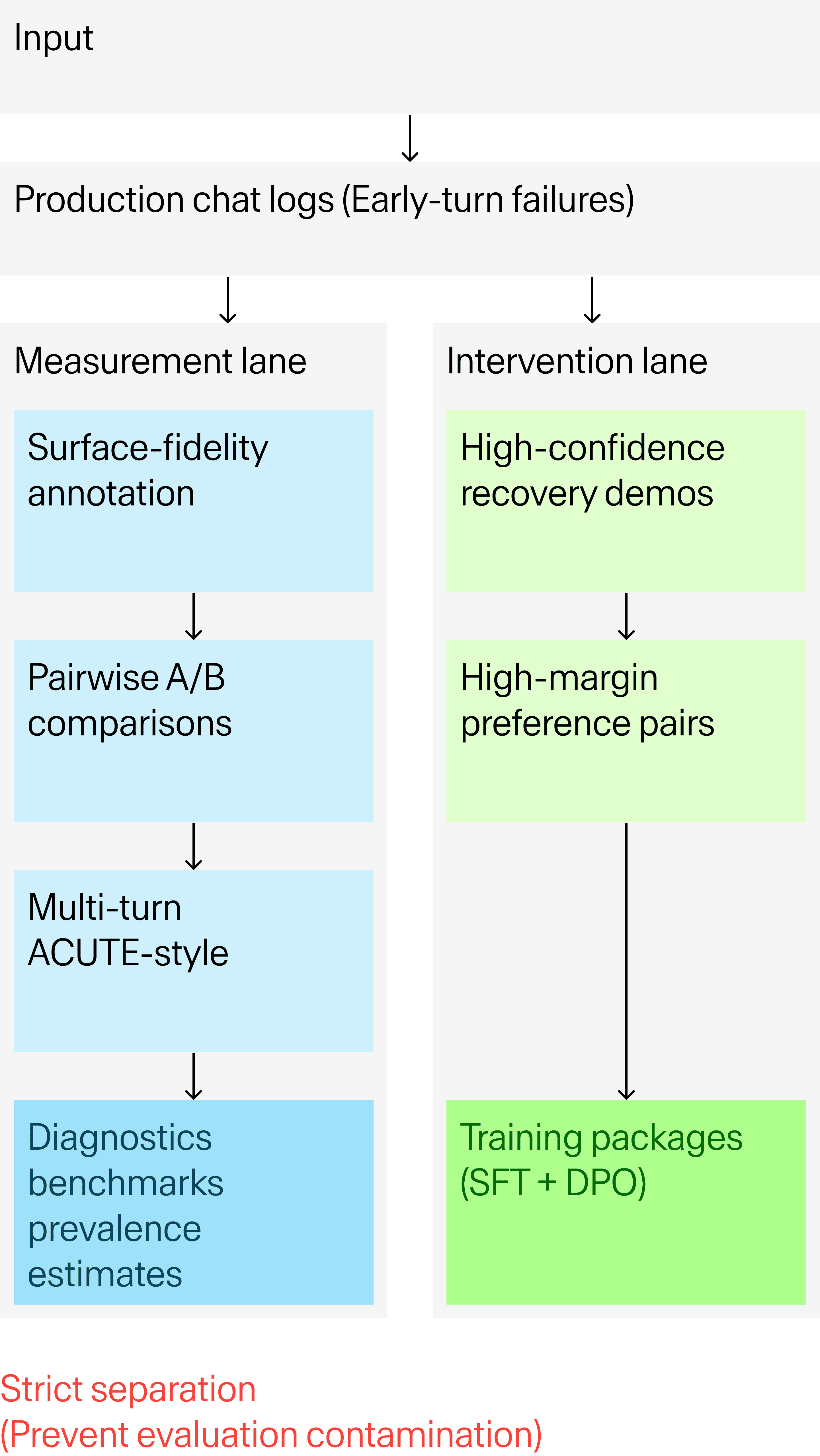
Strict lane separation
To prevent evaluation contamination from training drift, the pipeline maintains a rigid physical and temporal separation between the data used for measurement and the data used for model intervention.
Measurement Lane
Utilizes representative sampling to provide prevalence estimates and benchmarks. This data never touches the training set, ensuring a permanently held-out evaluation environment.
Intervention Lane
Utilizes carefully engineered sampling to maximize training signal. This high-density data prioritizing failure recovery serves as the primary corpus for model re-training.
Two-lane pipeline architecture
Automated triage and recovery authoring
Every early-turn episode undergoes automated triage to distinguish between successful, low-cost interactions and failure-driven breakdowns. This step is critical to ensure the model is not inadvertently trained to extend sessions where the user's intent has already been satisfied.
By isolating these "frictional" terminations, the pipeline can focus exclusively on episodes requiring intervention, effectively converting previous failures into progress without increasing the model's verbosity.
To generate these interventions, we extract recoverable responses from a blend of human-authored examples and successful model-native recoveries mined from production. These candidates are then refined through pairwise preference testing, utilizing explicit "tie" and "both bad" options. This rigorous filtering process reduces noise and ensures that only high-quality, successful recovery paths are used for subsequent training.
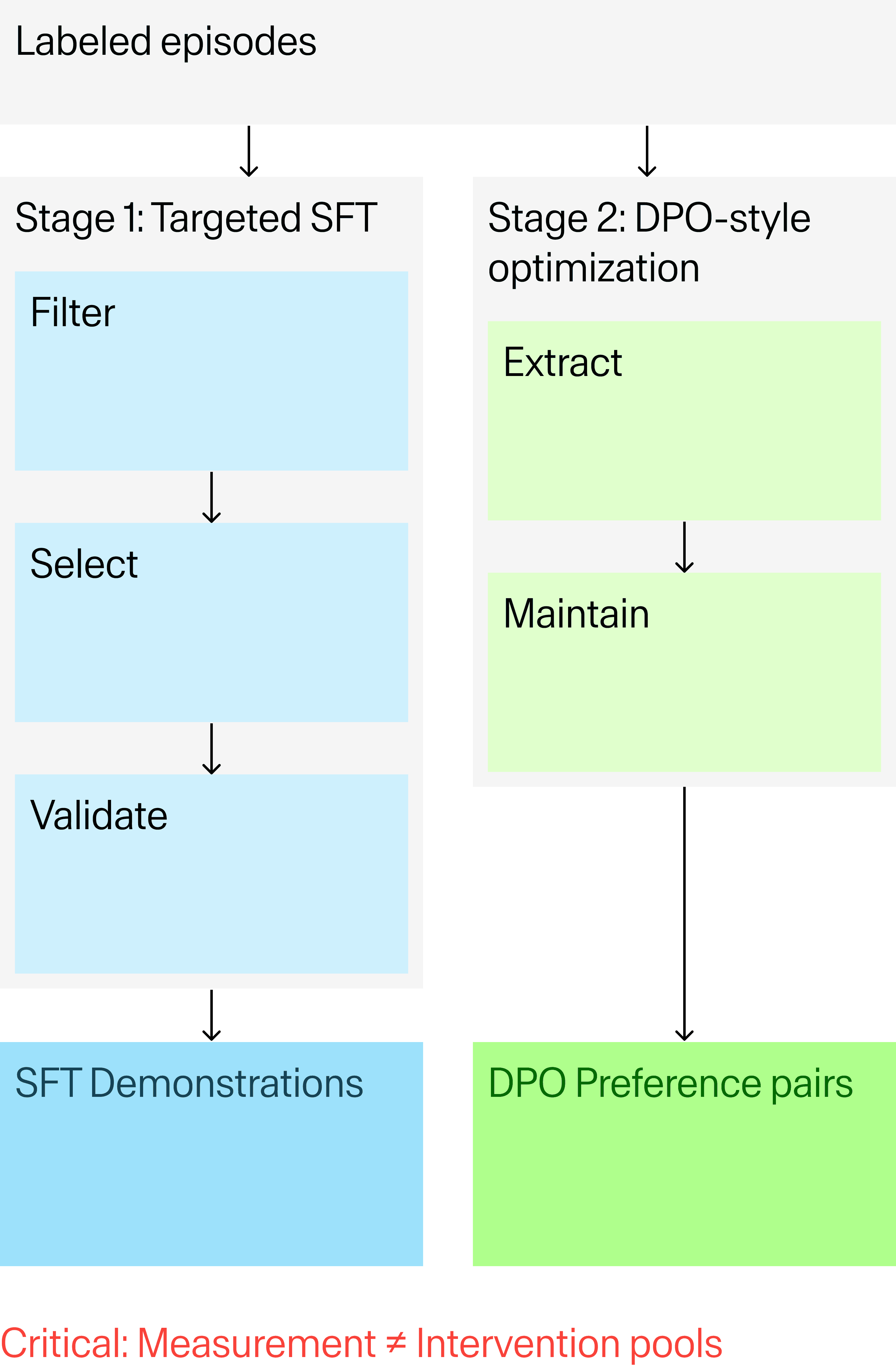
Training signal extraction: SFT & DPO filters
The intervention data is processed through two distinct filters to generate high-fidelity training packages.
Targeted SFT (Supervised Fine-Tuning):
Targeted SFT uses high-confidence winners as demonstrations. The output is a set of "gold" demonstrations where the model is told to "do exactly this".
DPO (Direct Preference Optimization):
We extract high-margin preference pairs where the gap between the win/loss is decisive.
Validation and stop-gates
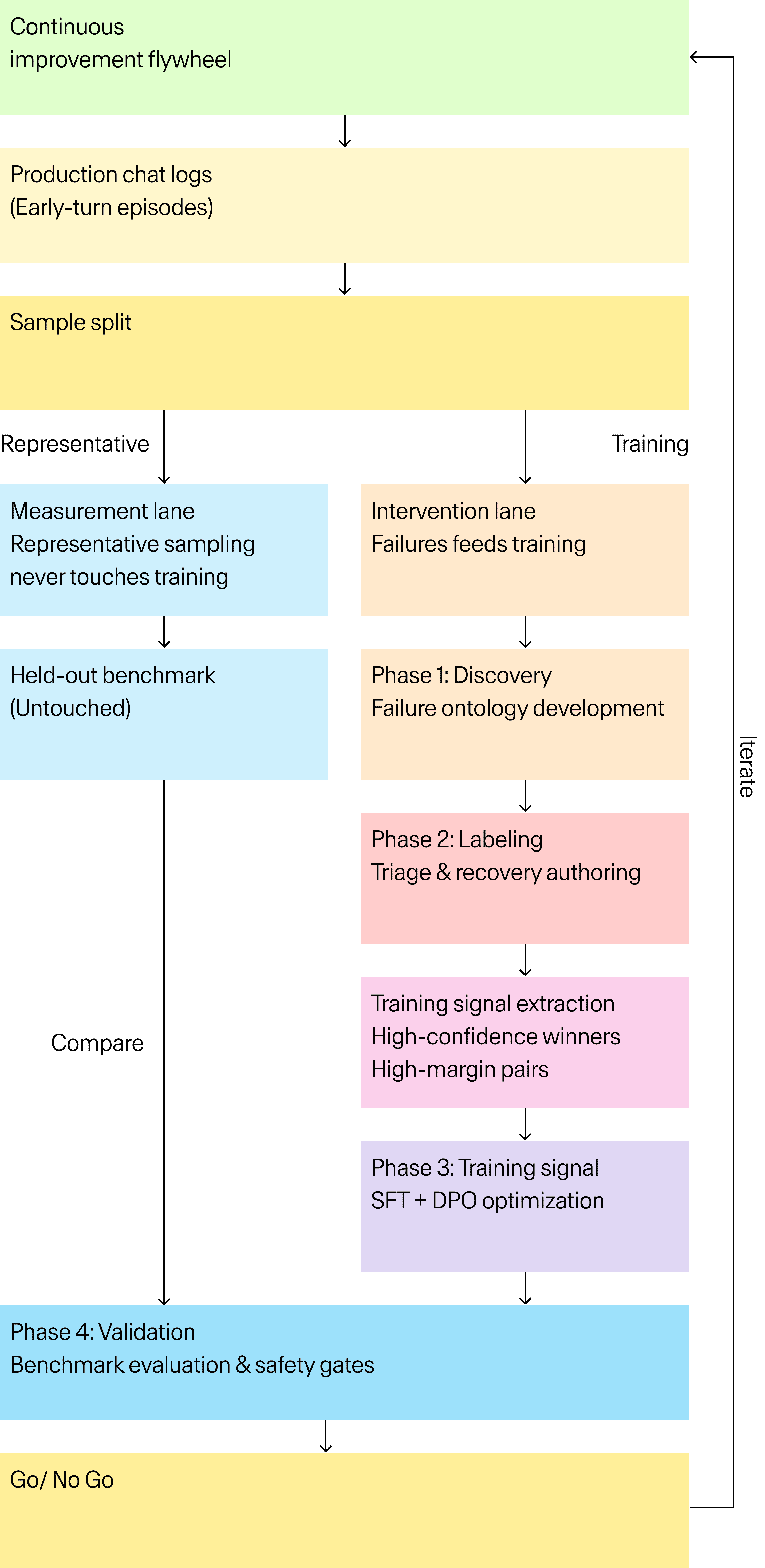
The iterative flywheel
This is a recurring cycle. As common failures are resolved, new patterns emerge. The architecture allows for the measurement lane to be refreshed with new representative samples without contaminating historical benchmarks.
Early-turn failure recovery pipeline
Empirical failure mode discovery
Recovery playbooks
Training signal