← Blog
/

How Lovi.Care uses Toloka for real-world QA, data labeling, and algorithm updates
Toloka Arena is live. See how your model ranks.
Lovi.Care is an AI skincare app that scans your face, evaluates cosmetic products, and generates personalized routine recommendations. Because the face scanner is central to the user experience, it’s also the highest-risk feature to ship with undetected issues.
To stress-test their mobile builds ahead of releases, collect diverse data, and calibrate complex algorithms, the Lovi team turns to the Toloka Platform.
Here is how they use real-world contributors to continuously improve a highly technical product.
1. QA that reflects real-world use (and unpredictable users)
Automated testing doesn't always catch what real users encounter in the wild, and even the best internal QA teams can’t simulate every possible device setting or user behavior.
Instead of relying solely on internal testing, Lovi uses Toloka to get fresh installs on real devices, with real people going through onboarding exactly as a first-time user would. Contributors install the app from an Expo build link, complete the full activation flow, and submit a full-screen recording of the session.
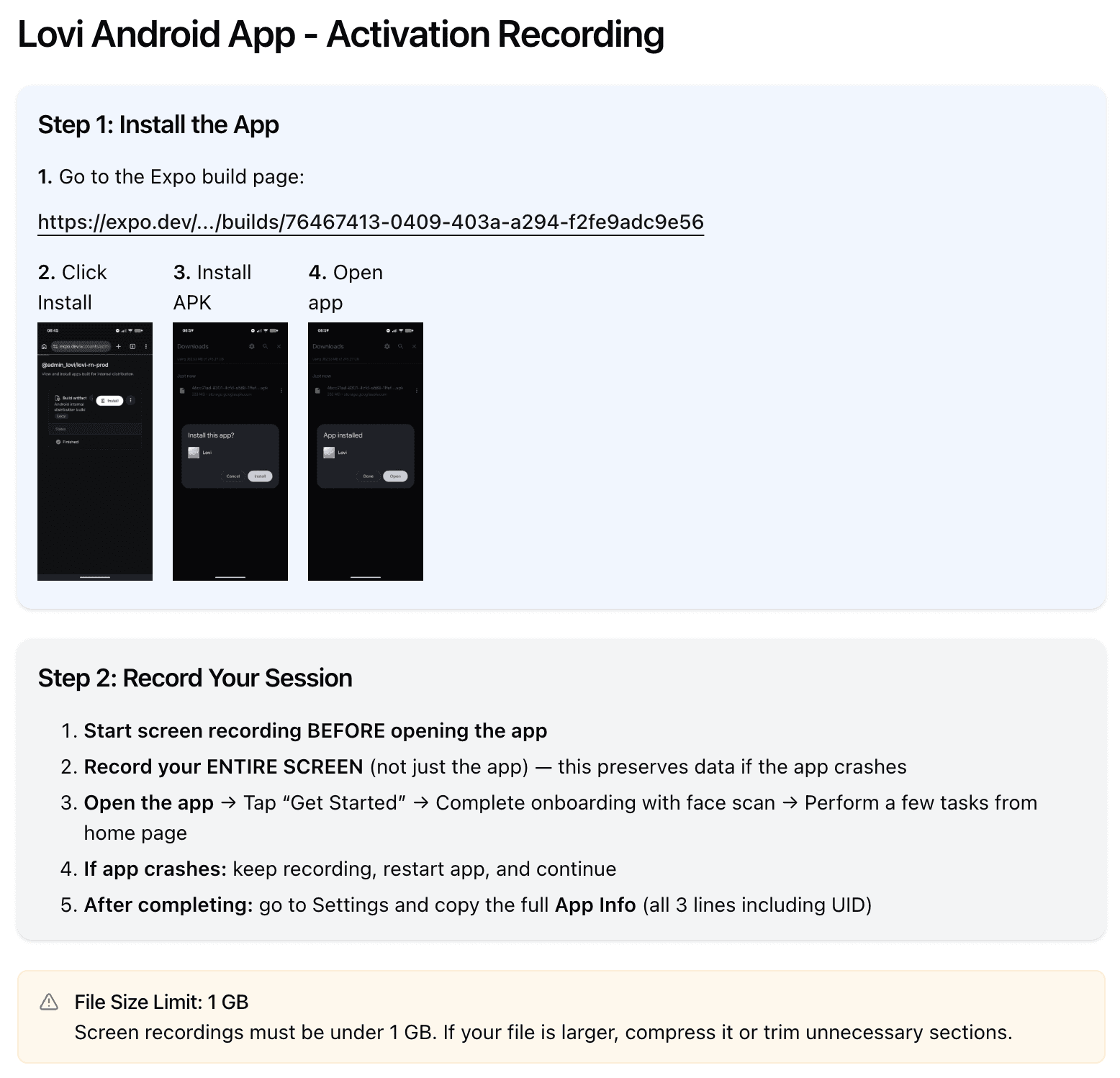
This approach helps uncover edge cases that are physically impossible to simulate on standard test devices.
"Toloka testers always find some failure modes that we couldn't think of ourselves. For example, before our first public release, one user turned their phone into landscape mode and the interface completely broke. Somehow, no one on the team managed to think of doing that! Moreover, on my phone, this mode is simply locked, so I couldn't even theoretically perform this test."
Running a new product on hundreds of phones in a matter of hours gives the Lovi team live recordings, feedback, and crash reports that are invaluable for a large launch.
The results:
Speed: Setup to project launch took just 50 minutes.
Efficiency: Every test scenario was completed and labeled in under a day.
Clarity: The structured recording format made every issue reproducible, giving the team a timestamped record to work from instead of a vague, written bug report.
2. Collecting real user data to cover corner cases
Beyond QA, Lovi leverages Toloka to collect data for labeling. For a skincare app, having authentic, varied data is critical so their medical team can properly annotate it and train supervised models.
While natural user data is great, it rarely covers every possible corner case. Toloka allows Lovi to step in and target narrow, specific conditions, guaranteeing they get the exact data their models need most.
3. Fast algorithm adjustments without starting from scratch
For ML teams, major feature updates, like overhauling an app's face scanner, often create a ripple effect. When the camera pipeline changes, it shifts the feature distribution for downstream models. Because the team doesn't have ground truth data tied to these new distributions, training algorithms from scratch isn't a viable option.
Instead of taking the time-intensive route of re-labeling thousands of new photos, Lovi uses Toloka for a much more efficient workaround:
"We simply launch a pipeline on Toloka, collect a few hundred data points, and make adjustments to the algorithms so they reproduce the behavior of the prior versions, but with new inputs. That way, we can easily make large algorithmic updates without the need for extremely hard and time-inefficient solutions such as, for example, re-labeling thousands of photos after each camera update."
Shipping a complex mobile app? Test it with Toloka
Whether you need to collect data, calibrate algorithms, or run structured QA with real users, Toloka’s self-service platform gives you access to a massive pool of contributors ready to test.
No lengthy onboarding, no minimum spend. Set up your first task, get hundreds of real-world sessions in a matter of hours, and find the edge cases before your users do.
Subscribe to our newsletter
Product updates, case studies and the latest news from our team, straight to your inbox